A thin market.A thin market.Nothing inventedNothing inventedto fill it.to fill it.
Pi Terminal reads the exchange, the banks, the treasury tape and the state enterprises — and turns them into diligence, IPO preparation and M&A work you can hand to a committee.
Every panel in the terminal states what it rests on. This one is the exchange's own prints — no estimate, no fill, no smoothing.
- 8
ESX listings
every name on the board
- 27
Banks
audited statements across 21 reporting years
- 30
State enterprises
transcribed statements, the pre-IPO pipeline
- 199
Licensed institutions
the NBE register
- 15
Macro series
rates, prices and trade
- 0
Headlines
tagged to the names they are about
Counted from the cache behind this page, last synced 2026-10-14. Every figure on the board and in the tape is the exchange's or the National Bank's own print, shown on the date it was printed.
This is the screen
Three of the nine surfaces, captured from the running terminal. Every figure on them is one the exchange or the National Bank printed.
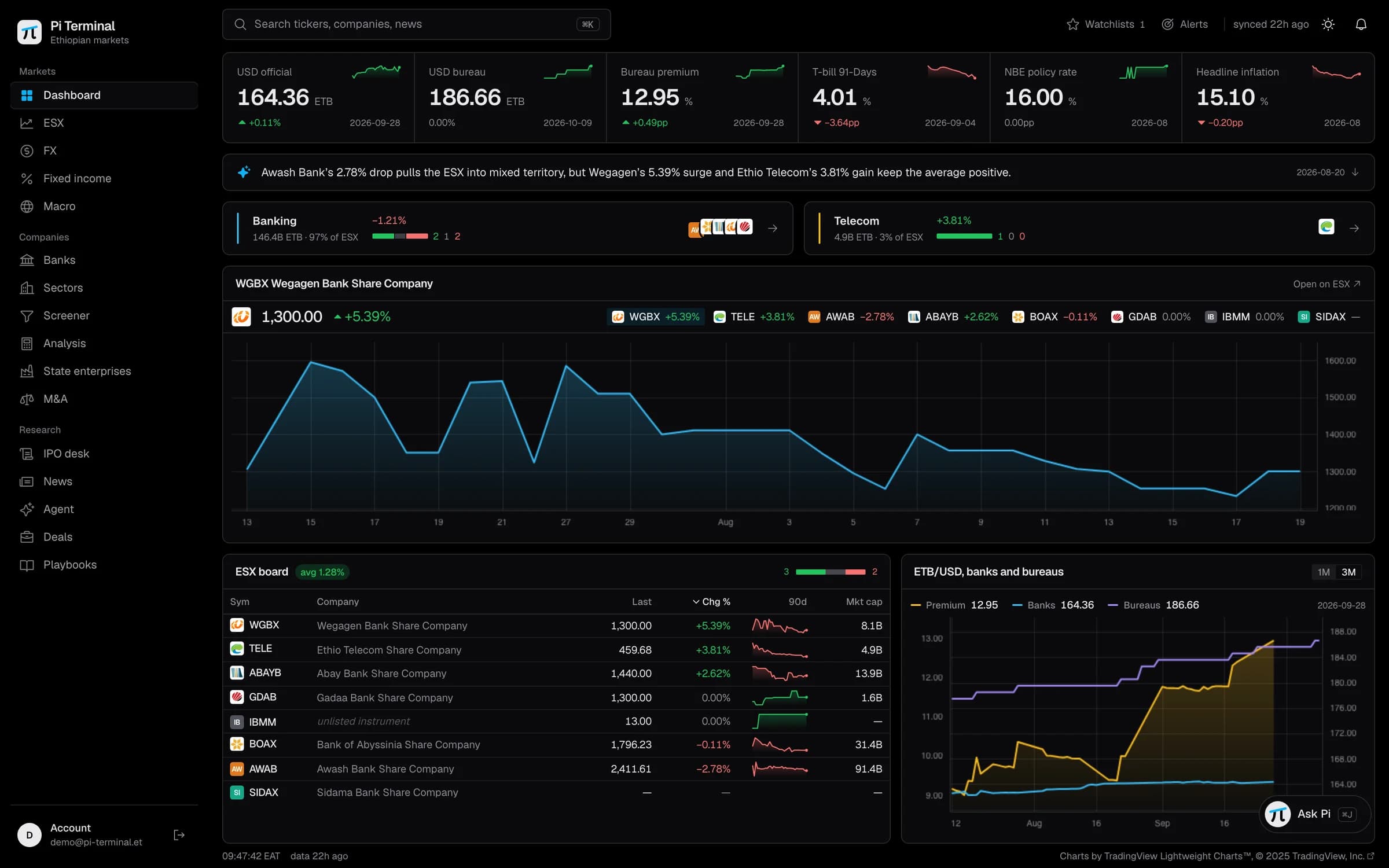
Six rates, each with the day it was printed. The board under them, the birr against the bureaus beside it — and not one figure on the screen without its own as-of date.
Nine surfaces, one market, no imported assumptions
Each desk is built around what this market's data can and cannot support. The constraints are the product.
Markets
The board, the birr and the treasury tape — each on its own clock.
- ESX technicals
- FX premium
- Treasury curve
- Macro
Companies
Audited statements, one identity per company, and a screener that refuses a bad ratio.
- Bank statements
- State enterprises
- Screener
- Mergers
Deal desk
Data room, diligence grids, drafting and a prospectus that exports laid out.
- IPO readiness
- Comparables
- Redlines
- Prospectus
Build on everything the terminal already knows
Go past a chatbot that recalls a figure. These are deterministic reads of the cached filings, composed into work that repeats exactly.
- 13 market tools, composable
Build a workflow once, and have it rest on the same evidence every quarter
How it worksConsolidation screen4 steps0 of 4- 1capital_pressurethreshold 5,000,000,00010 banks below the bar · smallest shortfall 851m · 2 do not report capital
- 2merger_combineZemen Bank + Enat Bank115.8bn combined assets · rank 9 and 19 become 7 of 26
- 3peer_comparisoncompany: Zemen BankTotal assets 9 of 27 · ranked on reported absolutes only
- 4Write the committee notefrom the evidence above, nothing elseTen banks report less than five billion birr of paid-up capital. Zemen and Enat combine to 115.8bn of assets, moving from 9th and 19th to 7th of 26…
The three tool steps return the same figures on every run. Only the last step asks a model, and it writes from what they found.Tool steps read the terminal directly. Press run.
- 12 weighted factors
A diligence rubric that withholds its own score when it cannot answer enough of itself
See the rubricOverallwithheldcomputing…answered 49 of 100 points- Use of proceedsnot on filenot in the file
- Shareholdingnot on filenot in the file
- Related partiesnot on filenot in the file
- Litigationnot on filenot in the file
- Transfer restrictionsnot on filenot in the file
- Cash conversionclear564.15m of profit became 497.18m of cash — 88%
- Profit trendclear331.34m in FY2021/22 to 564.15m in FY2022/23
- Audit opinionflagqualified, with 5 audit findings behind it
- Leverageflag800.22m of liabilities against 2.62m of equity — 305.8×
- Equity baseflagequity is 0.3% of 802.83m of assets
- Panel standingwatch28 of 30 state enterprises by total assets
- Price historynot on filenot listed, so there is no traded price
Ethiopian National Lottery Administration: 3 flags, and 5 disclosure factors with nothing behind them. Below 60% answered there is no headline score — a number travels and its caveat does not.
- Pick any two of 27 banks
What a combination actually looks like, computed in front of you
How it worksReported Zemen2025 Enat2024 Combined Total assets 88.6B 27.2B 115.8B Profit after tax 5.9B 555.2M 6.4B Rank by assets9 · 197 of 26Share of panel 3.24%Panel HHI 1702 → 1706- the sides do not share a reporting year (2025 and 2024); the sum spans two balance sheet dates.
- Only reported absolutes are summed. No ratio is added, shares in issue are not added at all, and no synergy or purchase accounting is assumed.
- Page-cited, or not shown
Ask a filing a question and get the page behind every claim
How it worksHow will the proceeds of the offer be applied, and in what amounts?answered from the filingETB 1,200,000,000 of the net proceeds is applied to a new production line and ETB 300,000,000 to working capital. The filing does not state an amount for issue expenses.
and ETB 300,000,000 to working capitalpage 11 · use of proceeds
ETB 1,200,000,000 of the net proceeds to a new linepage 11 · use of proceeds
a further ETB 90,000,000 is reserved for dividendsdropped — this sentence is not in the document
- One identity per company
Every record about a name, and the register each link was matched in
How it worksOne company, four registers and the headlines tagged to it. Hover a node to see which register the link was matched in. - A months-old exchange
Indicators that name what the history cannot carry instead of drawing it
How it worksWegagen Bank · 51 closes20-day average1,327.08RSI (14)46.2MACD−33.42From peak−18.5%Volatility (20d)56.9%Not enough history yet
Every panel above is live, and runs on figures read out of the terminal's own cache on 2026-10-04. Each carries the year it was reported — a page about not inventing numbers cannot illustrate itself with invented ones.
Not testimonials. Findings.
Three things the terminal turned up in the cache behind this page. Every one is checkable against the filing it came from.
“One bank reports paid-up capital at 0.01% of its own assets. No licensed bank is. The figure is set aside, not ranked as the weakest bank in the country.”
Merger desk · capital screen“Ethiopian Airlines turned 48.98bn of profit into 102.81bn of cash from operations. The National Lottery Administration carries 305× leverage behind a qualified opinion.”
IPO desk · diligence rubric“BOAX has 23 closes. A 50-day average through them is a made-up line with a confident label, so the terminal names it as unavailable instead of drawing it.”
ESX · technicals
- 01 · Ask
A question with a real answer in it
“Is Awash stretched, and on how much history?” It is a question about this market, which means the honest answer depends on data that barely exists yet.
- 02 · Retrieve
The evidence is gathered before a model sees anything
The board, the closes behind it, the statements filed under every spelling of the name, and the headlines the ingest tagged to it. Ranked, then handed over.
- 03 · Compute
Every figure comes out of code, not recall
RSI, the moving averages, the drawdown — each from a deterministic path over the closes. And where fifty-one closes cannot carry an indicator, it is named rather than drawn.
- 04 · Cite
The answer carries what it rests on
The figures, the window they were read over, and the date each was last printed. A claim with nothing behind it does not reach the page.
A question with a real answer in it
“Is Awash stretched, and on how much history?” It is a question about this market, which means the honest answer depends on data that barely exists yet.
The evidence is gathered before a model sees anything
The board, the closes behind it, the statements filed under every spelling of the name, and the headlines the ingest tagged to it. Ranked, then handed over.
Every figure comes out of code, not recall
RSI, the moving averages, the drawdown — each from a deterministic path over the closes. And where fifty-one closes cannot carry an indicator, it is named rather than drawn.
The answer carries what it rests on
The figures, the window they were read over, and the date each was last printed. A claim with nothing behind it does not reach the page.
Awash is not stretched. RSI sits at 38.0 against the 70 that would read as overbought, and the price is 19.5% below its own high over 51 closes.
The difference is what happens when the data is thin
Months of price history, statements filed under two spellings, ratios in two unit systems. Anything that hides that is lying to you politely.
| What this market does | Anywhere else | Pi Terminal |
|---|---|---|
| A bank under two spellings | Two rows, ranked against itself | One companyfolded on name |
| A ratio in two unit systems | Sorted by reporting convention | Derived herefrom two absolutes |
| 23 closes and a 50-day average | A confident line | Named unavailablewith the shortfall |
| A figure the model recalled | Plausible, unsourced | Computed in codewith its as-of date |
| Last quarter's analysis | Redone by hand | A saved workflowsame evidence |
Four sources, and none of them is a model
Nothing in the terminal is estimated, modelled or filled in. If a source has not printed, the panel says so.
- Ethiopian Securities ExchangeEvery listing and every print on the board, with the date it was printed.
- National Bank of EthiopiaOfficial FX, the policy rate, treasury auctions, open-market operations and the licence register.
- Audited statementsBank financials across 21 reporting years, and transcribed statements for 30 state enterprises.
- stockmarket.etThe headline feed, tagged to the names each story is actually about.
 ENA
ENA Capital Ethiopia
 The Reporter
 Birr Metrics
 Addis Fortune
 Addis Insight
 2merkato
 Ethiopian Monitor
 Ethiopian Press Agency
 stockmarket.etSHShegaEBEthiopian Business Review
A deal desk has to be able to run both sides
Information barriers, audit trails and isolation are not features here. They are the condition of being usable by a firm at all.
- Session tokens verified against JWKS; the API never writes the auth tables
- Deal data isolated per firm, proved across every deal-scoped route
- Sign-in, sign-up and reset rate limited at the edge and in the app
- Every deal action written to an audit log the lead can export
- An information barrier so one firm can run both sides of a transaction
The honest answers
The five things a desk asks before it will trust a figure on a screen.
Where do the figures come from?+
The exchange, the National Bank, published audited statements and the stockmarket.et feed. Nothing is modelled, estimated or filled in. Every figure on a panel carries the date it was last printed, which is often not today — the treasury tape, the bank statements and the exchange all move on different clocks.
Does the AI make up numbers?+
It is not asked to. Every figure comes from a deterministic read of the cache, and the model's job is to narrate what those reads returned. In a saved workflow the tool steps run with no model in the loop at all, so the same workflow rests on the same evidence every time it runs.
What happens when the data is not there?+
It says so. An indicator without enough history is named as unavailable with the exact shortfall. A diligence factor with no evidence is left unscored, and the overall score is withheld entirely when too little of the rubric could be answered. A citation the document does not contain is dropped rather than shown.
Can my firm run both sides of a transaction?+
Yes. A deal can be restricted so only its owner and explicit members reach it, even for an org admin. Tenant isolation is proved across every deal-scoped route, and an unshared deal id reads exactly the same as one that never existed.
Is the market big enough for this?+
The exchange opened recently and the deepest name has about fifty closes. That constraint is the reason the terminal exists in this shape: everything in it is built to be honest about a thin market rather than to paper over one.